
Ferns Old Graveyard Conservation Report
Background to the Project
The Ferns Old Graveyard conservation report was commissioned by Ferns Community Development in association with Ferns Tidy Towns and Ferns Project groups with funding provided through the Heritage Councils Community Heritage Grant Scheme 2025.
The policies and recommendations in the report aim to enhance and conserve the old graveyard.
Objectives
The Ferns Old Graveyard conservation survey and plan will enable local stakeholders to establish a framework which will ensure the preservation and enhancement of the site for future generations and achieve the following aims.
- To understand the historical and archaeological significance of the site
- Preserve the built heritage of the old graveyard and address the condition of the boundary wall
- To assess, identify, evaluate and mitigate against current threats and vulnerabilities to the old
graveyard - To preserve and enhance the sites biodiversity and mitigate against climate change
- Create awareness of this historic graveyard and ensure its preservation for locals and visitors alike
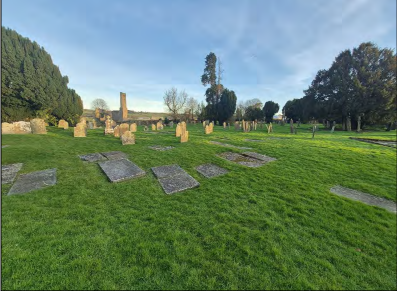
Historical Significance
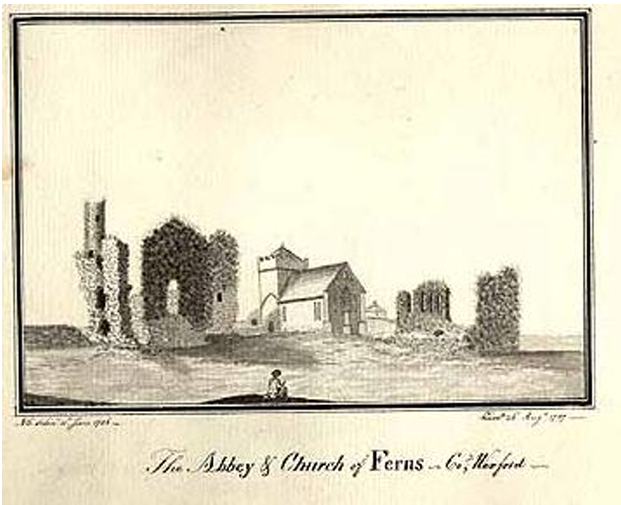
Ferns Old Graveyard was the site of a major 6th-century monastic foundation by St. Aidan (Mogue) and remained an important ecclesiastical centre throughout the medieval period. The site shares an association with St. David of wales through historic and modern cultural connections. It is the final resting place for some notable historical figures including Fr. John Murphy (1798 Rebellion) and Dermot MacMurrough, King of Leinster (traditionally).
Archaeological Significance
The Old Graveyard is situated upon the site of an important medieval monastic and ecclesiastic centre, is designated a monument under the National Monuments Act 1930-2014 and is listed within the record of monuments and places (RMP) (Reg No. WX015-003008) with three other monuments within its confines; a high cross (WX015-003013), cross slab (WX015-003030) and sub-surface archaeological remains of an ecclesiastical enclosure (WX015-003031). It contains ex-situ medieval masonry within its
grounds and built into the boundary walls. Memorials within the graveyard display unique designs and iconography, reflecting local vernacular craftsmanship. Sub surface archaeological remains within the site form an important part of the archaeological resource both locally and nationally
Architectural Significance
The boundary walls of Ferns Old Graveyard are defining architectural and spatial elements that continue
the historic ecclesiastical enclosure first established over a millennium ago. They delineate the sacred perimeter of the early monastic and later medieval graveyard, preserving the spatial organisation and enclosure traditions that have framed this burial landscape for centuries. Constructed primarily from locally sourced greywacke and siltstone, laid in random or roughly coursed rubble with traditional lime based mortars, the walls exemplify vernacular Irish craftsmanship and the enduring use of indigenous
materials.
Medieval masonry survives within the graveyard grounds and is incorporated into sections of the boundary wall, representing rare and tangible evidence of early ecclesiastical construction and later adaptation. Embedded carved fragments and re-used dressed stone reflect centuries of alteration and repair, revealing how historic builders reused material from earlier ecclesiastical or funerary structures. These features offer direct insight into local building traditions, medieval ecclesiastical design, and patterns of stone recycling typical of long-lived sacred sites.
The walls form a coherent visual and structural framework that defines the setting of the graveyard, maintaining the historic relationship between enclosure, access, and landscape. They embody both functional and symbolic roles providing containment and protection while also expressing the sacred delineation of consecrated ground within the townscape of Ferns.
The memorials within the graveyard further demonstrate the evolution of commemorative practices and stone-carving traditions from the seventeenth to the twentieth centuries. Together with the boundary walls, they illustrate the continuity of craftsmanship, devotion, and cultural expression within the same enclosed space.
Collectively, these elements present one of the few largely intact ecclesiastical enclosures surviving in County Wexford. Their authenticity layered construction history, and patina of age make them a significant component of the region’s architectural heritage and a vital record of the evolving relationship between community, craft, and sacred space.
Ecological Significance
The graveyard site is evaluated as of county conservation value due to the occurrence of Harebell (Campanula rotundifolia), This is the only site in Wexford where it is found. The site is also of high local importance and possibly of county significance for the presence of the locally rare bryophytes – the liverwort Porella platyphylla and the moss Gymnostomum viridulum that grow on the walls. Bee hives present in the woodland retain the native black bee Apis mellifera mellifera. The walls also support a range of herb species, ferns, bryophytes and lichens.
Social Significance
The graveyard was a shared burial ground for both local Catholic and Church of Ireland communities. Despite being closed to new burials since the early 20th century it is still regularly visited reflecting an ongoing local importance.
Please read the following links to find out more about the findings and recommendations in the Old Graveyard Conservation Report. A steering committee has been set up to implement and oversee the recommendations. We look forward to hearing your thoughts.
Appendix 1: Archaeological Assessment Ferns Old Graveyard by Barry Lacey
Appendix 2: Old Ferns Graveyard Conservation Management Plan 2025
Appendix 3: Ferns Old Graveyard Ecological Assessment Report
Ferns Graveyard Wall Survey – GA Drawings Phase 1
Ferns Old Graveyard Southern Wall Layout Plan

Leave a Reply