Category: Sustainable Living

Pollinator-Friendly Herbs to provide pollen rich food for our bees

No Comments

Our pollinating insects are in decline. One third of our 99 bee species are at risk of extinction.

There are 99 different species (types) of bees in Ireland. We have one honeybee, 20 different bumblebees and 77 different solitary bees. Bumblebees and solitary bees are known as wild pollinators. Research tells us that if we want our crops and wild plants to be pollinated we need an abundance and diversity of wild pollinators as well as healthy honeybees. While we may not be able to change the global situation on our own, each of us can try to make our gardens havens for bees by growing simple plants such as herbs.
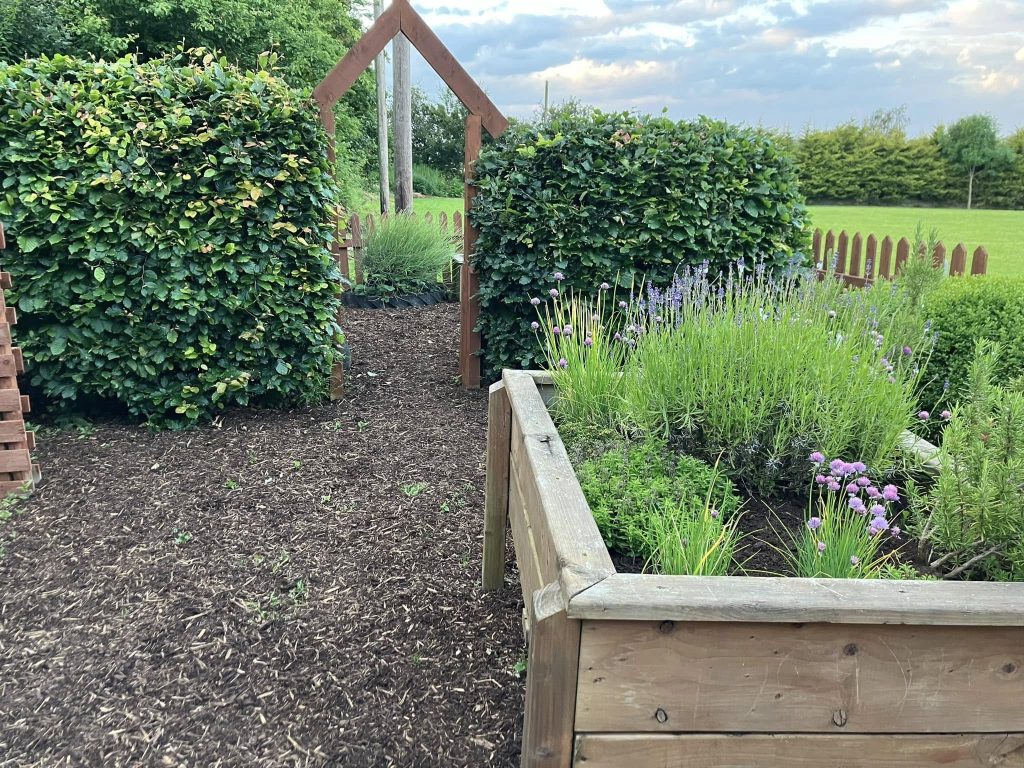
Pollinator-friendly raised herb bed at Ferns Tidy Towns Community Vegetable Garden

Herbs in our Gardens

Herbs are among the most useful plants for attracting bees to our gardens. They grow well alongside other garden species, or in specially designed areas, and some are suitable for containers. Low-growing herbs, such as thyme, can even be used to make fragrant green paths. By choosing pollen-rich herbs for your garden, you will help provide much-needed food for our Bumblebees and other pollinating insects as well as creating a colourful garden or planters that you can use. There are lots of pollinator-friendly herbs to choose from. Most herbs are adaptable to a range of soil and growing conditions and, for the most part, pretty easy to grow.
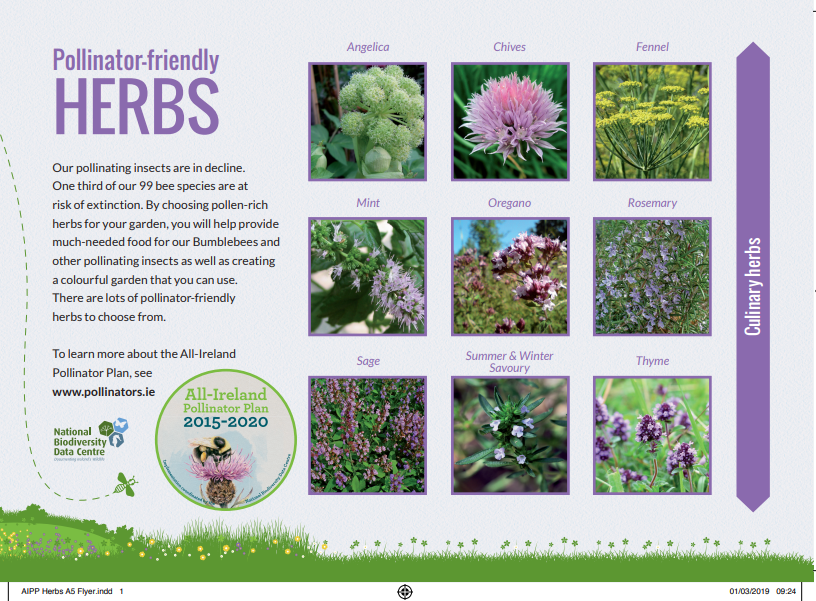
Good herbs for pots are: Thyme, Sage, Rosemary, Lavender, Oregano, Mint, Lemon balm and Chives. Be careful of Borage and particularly Mint which can spread. These herbs are all perennials and will come again each year.

Thyme:

Thyme is known for its fragrant leaves and flowers that attract various bees and hoverflies. 

Sage:

Bees are particularly drawn to the blue and purple flowers of sage, providing a valuable food source. 

Rosemary:

This drought-tolerant herb has fragrant needles and blue-purple flowers that attract various bees, including mason bees, flower bees, bumblebees, and honeybees. 

Oregano:

This herb is a good source of nectar for various pollinators

Borage:

Borage boasts bright blue flowers that are very attractive to bees and butterflies,

Chives:

These herbs have pretty blooms and tasty stems and also attract bees and butterflies
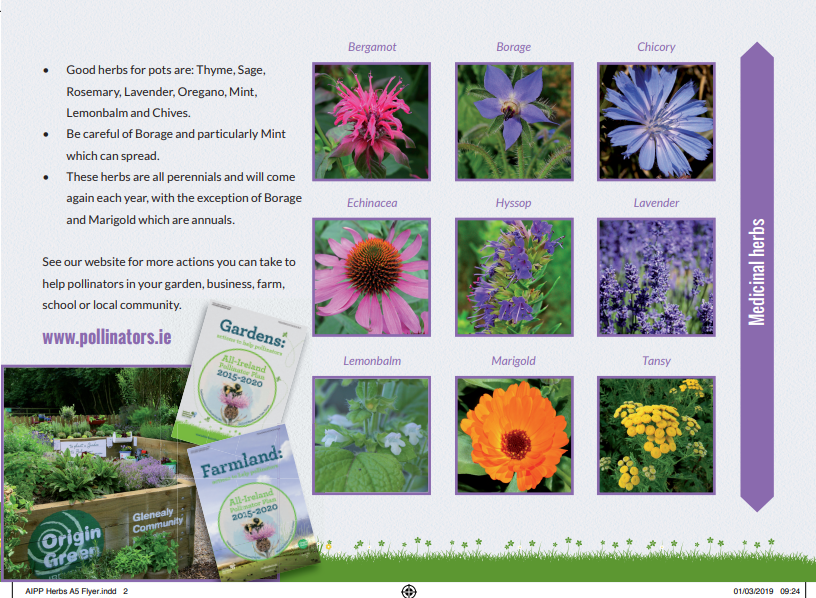
For more actions you can take to help pollinators in your garden, business, farm, school or local community see www.pollinators.ie

Categories: Sustainable Living

Make Your Garden a Haven for Biodiversity

No Comments

A booklet to assist everyone to help biodiversity by increasing wildlife in their gardens, no matter how big or small, has been recently launched. The brainchild of Juanita Browne, the booklet was produced by Laois County Council with the assistance of Local Authority Heritage Officers across Ireland. Also support from the National Parks and Wildlife Service and the Heritage Council.

Taking a very practical approach, the book details projects to help wildlife of all kinds under a range of headings, with tasks suitable for everyone from the total beginner to the more ambitious DIY enthusiast. With clear instructions and step-by-step drawings by illustrator Barry Reynolds, the guide offers the gardener lots of options to help our biodiversity.

Biodiversity in Your Garden Children’s Book

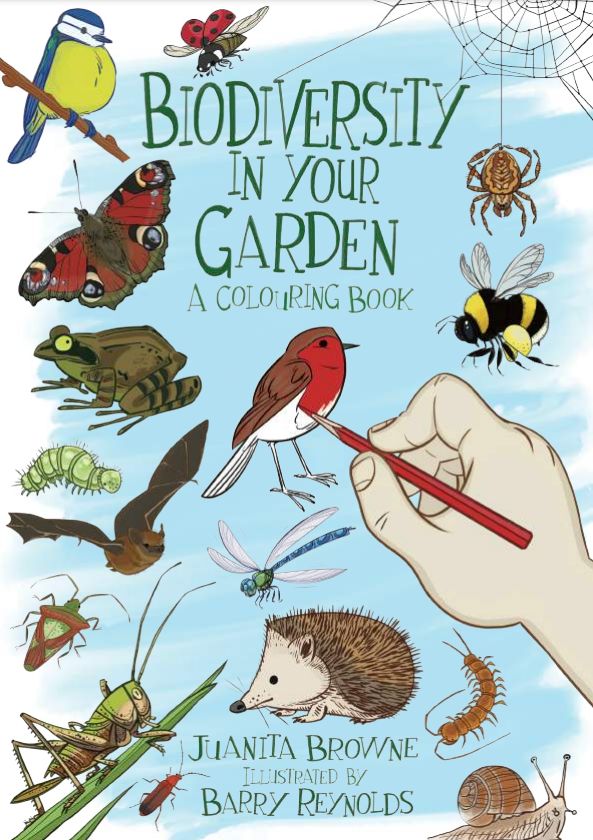
As a companion to the book, a children’s book with kid-friendly information on garden wildlife and colouring pages using Barry Reynolds’ fun original illustrations has also been produced.

New guide shows how to look after wildlife in your garden

With increasing agricultural intensification, gardens in many areas can be an oasis for wildlife, and with small changes we can make them even better. The guide outlines actions that can be taken to improve gardens for birds, bees, butterflies, bats and more, and the good news is many of the steps that can be taken are really easy. Just leaving an “untidy” corner of your garden for nature, leaving roadside verges to grow naturally or allowing some of the gold star plants for biodiversity – dandelion, willow, bramble, clover, ivy  – a spot in your garden can reap huge dividends for wildlife.

Every Garden Is Important

Inviting birds, butterflies, bees, wildflowers, and trees into your own garden won’t just help the planet, it will help you too!

A sterile garden, with tightly mown grass, or hard/artificial surfaces, offers humans no exposure to nature, no buzz from busy insects, no birdsong, no life. People feel better when they are surrounded by nature and indeed this sense of wellbeing increases directly with an increase in biodiversity – the wilder the area, with more different types of plants and animals, the better you will feel!

A visit to a town park with tightly mown lawns cannot compare to how good you feel on a walk through a wildflower meadow or a semi-natural woodland. So just imagine the health benefits of bringing some of that feel-good nature right to your back door!

To find out more about how you can create a haven for wildlife you can download Gardening for Biodiversity and Biodiversity in Your Garden – A colouring Book for your mini gardeners. Lets work together and make small changes that will make a big difference to our biodiversity.

A new series of short films has now been made to accompany the book – click below for more:

Rethink for a more sustainable life

No Comments

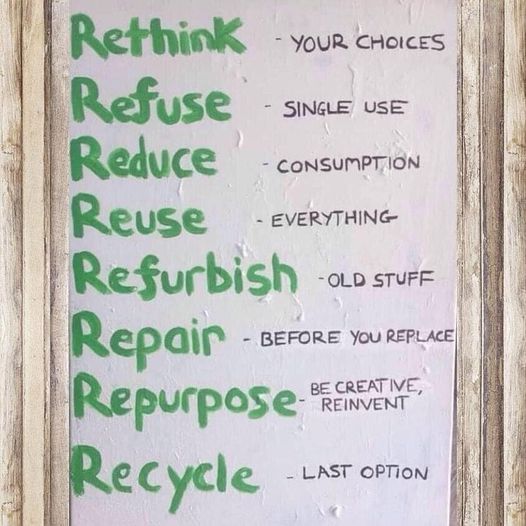
The R’s help reduce plastic waste and closes the loop on consumables.

Often, in our throwaway society, items are purchased to be used for a short while, sometimes only minutes. Referencing the Rs helps individuals, communities and businesses to make more sustainable choices.

Rethink your choices

💡Rethink – Many people consider this the first choice in helping to reduce plastic waste. Just stopping to rethink if an item is needed at all reduces waste in general.

💡Refuse – Simply choosing to refuse single-use items, and opting for plastic free alternatives and reusables, reduces waste of all kinds.

💡Reduce – Before making a purchase, ask yourself if it’s truly needed or if another item can be used instead. Choosing to shop for secondhand items helps reduce new product consumption and contributes to less waste.

💡Reuse – Many households simply reuse or repurpose what’s already on hand. Items like food containers, clothing, bags, toys, art supplies, tools, sporting goods, etc. Consider reusing items as much as possible or take them to a secondhand store, so they don’t end up in landfill.

💡Refurbish – Numerous household items, furniture, electronics, etc. can be refurbished to good working order to avoid discarding and buying new.

💡Repair – Clothing, shoes, sporting goods and household items can be repaired to avoid creating more plastic and waste in general.

💡Recycle – Once an item has reached the end of its life, recycling correctly helps reduce plastic ending up in landfill or as litter. When buying new items, consider choosing recycled products to close the loop.

What other R’s are out there to consider? refill, repurpose…

Rethink, Reduce, Reuse, Recycle, is well known as the mantra of sustainability. Waste prevention involves rethinking how we do things to avoid producing waste. By reducing the amount of ‘stuff’ we buy and use, we decrease the resources needed for manufacture, transport and disposal.

We also cause less impact on the environment where the materials originate, during their transport and where they are disposed of. We also save money by not buying ‘stuff’ we don’t need.

Reducing our consumption …. Our choices can make a difference!

As consumers, we can play our part by thinking about our consumption habits and considering the impact of the products we buy.

Categories: Sustainable Living